 |
Birdwatching wildlife
in Madagascar
God loves birds
and creates trees and forests,
Men love birds and create boxes !!!
|
|
Since a few years, Madagascar has become a privileged destination in ecotourism and wildlife. Madagascar, an enchanting island, an authentic country, which will please you for its diversity and for its welcoming people. Madagascar, one of the best destination in the world for discovery tour lovers and for trekking tour lovers. Madagascar, a destination off the beaten tracks.
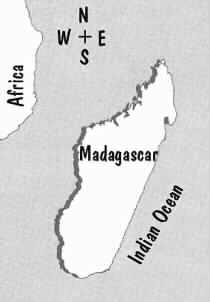
Through tectonic movement, Madagascar has a long separation from neighboring continents, it split from Africa about 160 million years ago, from Antarctica about 120 million years ago and from India around 90 million years ago ; because of this separation, it contains many endemic species. Of the 293 bird species recorded on Madagascar, about 110 are found nowhere else on earth.
For the Birdwatching wildlife passionate people :
Quantitatively the bird found in Madagascar is not as rich as those in other countries, but the difference is in its endemicity ( about 110 species ). The most favorable period for observation goes from september to november.
Where are the best sites to observe birds in Madagascar ?
The easiest because of infrastructure facilities are ANDASIBE PERINET - MANTADIA National Parks and RANOMAFANA National Park. The both occur on montane rainforest and on mid-altitude rainforest. You can see there for examples : the Cryptic Warbler, Rufous-headed Ground-roller, Madagascar Yellowbrow, Grey-crowned Greenbul, Brown Emutail, etc.
Some Madagascar National Parks to see endemic birds :
It's easy too to find them at IFATY, AMPIJOROA - ANKARAFANTSIKA, ZOMBITSE and ANDOHAHELA National Parks which occur on southern or western deciduous dry forest. Sometimes it's a spiny forest ( characterised by the cactus-like trees and the Didierea trees ). And sometimes, it's a fairly dense seasonally dry forest where it's difficult to penetrate. You can see there for examples : the Thamnornis Warbler, Subdesert Brush-Warbler, Subdesert Mesite, Verreaux's Coua, Running Coua, Lafresnaye's Vanga, Red-shouldered Vanga, Littoral Rock Thrush, etc. Or the Red-capped and Giant Couas, Coquerel's Coua, Sakalava Weaver, Appert's Greenbul, White-breasted Mesite, Sicklebilled Vanga, Van Dam's Vanga, etc.
Then you can too observe birds but more difficult beacuse of lack of infrastructure in these following regions : the lowland eastern evergreen humid forest such as MAROJEJY and MASOALA National Parks, and the West wetlands or the East wetlands ( the rivers, the lakes & the marshes of AMBOROMALANDY LAKE, IHOTRY LAKE, TSIMANAMPETSOTSA LAKE, KINKONY LAKE, ANTSALOVA, BETSIBOKA etc. or at VOHIPARARA, TOROTOROFOTSY and ALAOTRA LAKE ). You can see there for examples ( at West ) : the Sakalava Rail, Great-billed Heron, Humblot's Heron, Madagascar Teal etc. And at East : the Madagascar Rail, Madagascar Snipe, Madagascar Pochard, Madagascar Little Grebe, Meller's Duck, Yellow-billed Stork, Common Stonechat, etc. |
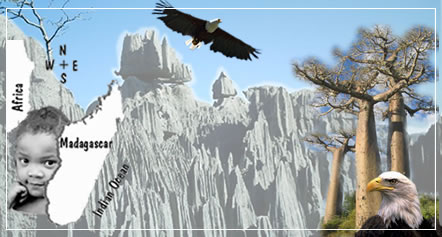
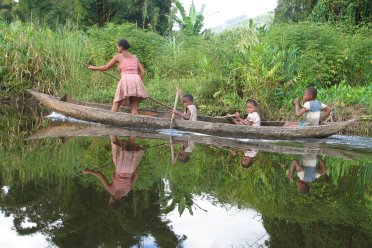
West part of Madagascar - Pierrette ( September 2006 ) ©
Madagascar's bird life is fascinating and of great value
List of Kind of Birds species in Madagascar :
For Madagascar non-passerines birds :
Penguins • Grebes • Albatrosses • Shearwaters and petrels • Storm-petrels • Tropicbirds • Pelicans • Boobies and gannets • Cormorants • Darters • Frigatebirds • Bitterns, herons and egrets • Hamerkop • Storks • Ibises and spoonbills • Flamingos • Ducks • Osprey • Hawks, kites and eagles • Falcons • Partridges and quails • Guineafowl • Mesites • Buttonquails • Rails, crakes, gallinules, and coots • Jacanas • Painted snipe • Crab Plover • Avocets and stilts • Pratincoles • Plovers • Sandpipers and allies • Skuas • Gulls • Terns • Sandgrouse • Pigeons and doves • Parrots and allies • Cuckoos • Barn owls • Typical owls • Nightjars • Swifts • Kingfishers • Bee-eaters • Typical rollers • Ground-rollers • Cuckoo-roller • Hoopoes
For Madagascar passerines birds :
Asities • Larks • Swallows and martins • Wagtails • Cuckoo-shrikes • Bulbuls • Thrushes and allies • Cisticolas • Old World warblers • Old World flycatchers • Wattle-eyes • Monarch flycatchers • Babblers • Sunbirds • White-eyes • Old World orioles • Vangas • Drongos • Crows • Starlings • Weavers and allies • Waxbills and allies • Sparrows
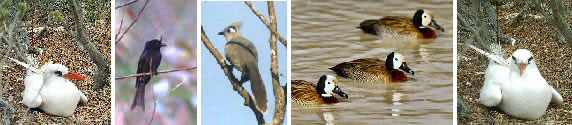
The Red-Tailed Tropicbirds (Phaeton rubricauda at left & at right) are Ravo's pictures Nov. 2007
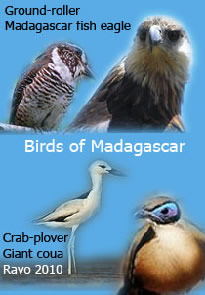
Just for examples let's comment the Birds of Madagascar pictures above :
1- ( From left to right ) Madagascar Tropicbirds :
Tropicbirds are medium-sized seabirds found primarily in tropical oceans ; they typically come ashore only to breed. They are predominantly white, with elongated central tail feathers. When hunting for the flying fish ( and occasional squid ) they feed on, they hover above the water, then plunge dive in after their prey. There are 03 species worldwide, all of which have been recorded in Madagascar. You can see the Red-tailed tropicbird at Nosy Ve islet near Anakao in the South coast of Madagascar ( Tropicbirds are Order of Pelecaniformes and Family of Phaethontidae )
2- Madagascar Drongos :
The drongos are mostly black or dark grey in colour, sometimes with metallic tints. They have long forked tails. They have short legs and sit very upright whilst perched, like a shrike. They flycatch or take prey from the ground. There are 24 species worldwide and only 01 species which occurs in Madagascar, the Madagascar crested drongo that you can find everywhere ( Drongos are Order of Passeriformes and Family of Dicruridae )
3- Cuckoos - such as Madagascar Coua roadrunners :
The family Cuculidae includes cuckoos, roadrunners and anis. These birds are of variable size with slender bodies, long tails and strong legs. There are 138 species worldwide and 12 species which occur in Madagascar ( Cuckoos are Order of Cuculiformes and Family of Cuculidae )
4- Madagascar Ducks and Teals ( small wild ducks ) :
The family Anatidae includes the ducks and most duck-like waterfowl, such as geese and swans. These are birds that are modified for an aquatic existence with webbed feet, flattened bills and feathers that are excellent at shedding water due to an oily coating. There are 131 species worldwide and 10 species which occur in Madagascar ( Ducks are Order of Anseriformes and Family of Anatidae )
Now, let's end with these three particular Madagascar Birds families :
5- Madagascar Hoopoes :
Hoopoes have black, white and orangey-pink colouring with a large erectile crest on their head. There are 2 species worldwide, one of which occurs in Madagascar ( Hoopoes are Order of Coraciiformes and Family of Upupidae )
6- Madagascar Weavers and allies :
The weavers are small passerine birds related to the finches. They are seed-eating birds with rounded conical bills. The males of many species are brightly coloured, usually in red or yellow and black, some species show variation in colour only in the breeding season. There are 116 species worldwide, four of which occur in Madagascar, one of them is the common bright red colour « Madagascar Red Fody » - Foudia madagascariensis - ( Weavers are Order of Passeriformes and Family of Ploceidae )
7- Madagascar Asities :
The asities are small plump bird, which are likely to be related to the broadbills. All four species are found only in Madagascar ( the Velvet Asity = Philepitta castanea, the Schlegel's Asity = Philepitta schlegeli, the Common Sunbird-asity = Neodrepanis coruscans and the Yellow-bellied Sunbird-asity = Neodrepanis hypoxanthus ) - Asities are Order of Passeriformes and Family of Philepittidae
An example of birding wildlife travel at the West of Madagascar :
Natural cathedrals, vast eroded karst pinnacles, crevices, grottoes & 360° viewpoint. To discover & to watch lemurs such as Sifaka lemur & many species of birds such as Madagascar Fish-Eagle (Haliaeetus vociferoides), Greater Flamingo (Phoenicopterus ruber), Madagascar Teal (Anas bernieri), White-faced whistling Duck (Dendrocygna viduata), Knob-billed Duck (Sarkidiornis melanotos), Madagascar Hoopoe (Upupa marginata), Cuckoo-Roller (Leptosomus discolor), Madagascar sacred Ibis (Threskiornis bernieri), Madagascar Paradise Flycatcher (Terpsiphone mutata), Madagascar Coucal (Centropus toulou), Madagascar Bee-eater (Merops superciliosus), Madagascar Kingfisher (Corythornis vintsioïdes), Madagascar Harrier-Hawk (Polyboroides radiatus), Madagascar Kestrel (Falco newtoni), Yellow-billed Kite (Milvus aegyptius), Gray-headed Lovebird (Agapornis cana), Greater & Lesser Vasa Parrot (Coracopsis vasa & Coracopsis nigra), Crested Drongo (Dicrurus forficatus), Egret species & Heron species, Humblot Heron (Ardea humbloti), Hamerkop (Scopus umbretta), etc. . This trip can be combined with the South-West of Madagascar to continue to explore Baobabs or with the Masoala National Park for a contrast ( Masoala National Park is a paradise pristine evergreen humid forest in Madagascar ).
|
You have to organize in advance an adventure trip.
It depends on professionalism,
on experiences & on passion
TRIP TO MADAGASCAR :
Madagascar, island of emotions, is a place like no other. Because of its insularity, it kept its traditions, its habits and customs, its fauna and flora with a high endemic character.
Madagascar has become very attractive for the amateur in search of new discoveries and emotions through hiking and trekking.
Being a professional Malagasy guide since 1993, I have organized and realized a heck of a lot of trips through Madagascar ; also I can make the following proposal to you.
There’s probably no better way to discover the real soul of this magnificent island than to penetrate deep inland in order to feel, touch, smell nature, to be fully submerged in Madagascar’s exuberant natural world. Of course there’ll be times 4WD vehicles and bivouacking will be necessary.
A trip to Madagascar provides an authentic nature experience for anyone seeking to experience it in a thoughtful and responsible way. Shall we see each other soon ?
Thank you for your TRUST.
D1 : Paris – Antananarivo ( Tana )
Welcoming reception at the airport and foreign exchange operation. Transfer to hotel.
D2 : Tana
A city tour of the Malagasy capital : the Artisan’s Marketplace ( possibility to shop ), the Zoological and Botanical Park ( discover here a synopsis of the local fauna and flora, a summary of the indigenous traditions and customs, a foretaste of what will lay ahead ), visit of the Upper and Lower Town of the capital as well as some interesting monuments. Your purchases can be safely stored at the hotel until departure (D17).
D3 : Tana – Morondava
Transfer to airport, flight to Morondava. Afternoon tour of the town and its markets, enjoy the spectacular sunset at the world famous Alley of the Baobabs.
D4 to D10 ( 7 days ) :
Morondava – Bekopaka – Morondava
You’ll be discovering amongst the finest landscape sceneries of Madagascar and experience some true 4x4 road conditions. You’ll be discovering the Baobabs region, the famous Tsingy of Bemaraha, a UNESCO World Heritage site, and a RAMSAR site ( area internationally recognised for its bio-and ecological interest ) ; for nature lovers and birdwatchers, this is it ! You’ll cross some typical Sakalava villages and meet its residents.
The journey includes hiking and trekking, pirogue trips on rivers and lakes, crossing mangroves and crocodile regions ( no fear of any danger, we’re not traversing a movie set ), walking through lemur inhabited forests, and of course a trek through the Tsingy.
For 3 nights we’ll be bivouacking in tents ( your OWN tent, see below for things to bring along with you ) ; the other 4 nights we stay at a hotel.
D11 : Morondava – Antsirabe
A long trip to reach the interior highlands. Discover the region known as the Malagasy Midwest, a kind of ‘No Man’s Land’; stops for pictures of Sakalava villages, volcanic massifs, etc.
|
|
D12 : Antsirabe – Tana
Visit workshops and stores of miniatures ( rickshaws, bicycles, trucks, … ), of embroideries, of precious and semi-precious stones. Discover the Central Highlands, the distinctive red lateritic houses, the numerous ricefields.
D13 : Tana – Maroantsetra
Morning transfer to the airport, flight to Maroantsetra. Afternoon free, stroll through this quiet town with its market rich in exotic fruits.
D14 to D16 ( 3 days ) :
Masoala National Park
With small power-driven boats we’ll be discovering a humid and dense primary forest environment, with some huge trees !
Please do not forget adequate rain gear, boots, mosquito repellent, swimming gear, plastic covers to protect your bags, as rains are frequent in this region. Plastic shoes may be handy for crossing shallow streams, and of course most useful : toilet paper.
Hiking and trekking through rivers and streams, waterfalls, forests with lemurs, birds, frogs, lizards. From time to time we’ll follow quasi-deserted beaches, your opportunity for a refreshing swim.
We’ll spent 3 nights bivouacking in tents ( yours! ) ; the river with its crystal clear water will be your washbasin, and nature will provide the ‘bathroom’.
With the journey in the West, we’ll spend a total of 6 nights bivouacking in tents.
D17 : Nosy Mangabe – Maroantsetra – Tana
Return to Maroantsetra by boat, transfer to the airport, and flight to Tana. Transfer to hotel; recover your purchases, farewell dinner. Transfer to the airport for flight back to Paris.
Cost estimation PER PERSON :
for a couple : 2535 euros
for 4 persons : 1870 euros
for 8 persons : 1700 euros
Price is all inclusive, except for :
Your international flight, visa, personal insurance, personal purchases and expenses, tips, luggage porter at airports and hotels, drinks
You’ll settle all bills locally as we progress through the journey, i.e. in Euros and local currencies.
TO BRING ALONG WITH YOU :
Your own tent, pegs, mattress, sleeping bags ; anti-mosquito spray and cream, pocket torch and spare batteries, head torch if possible, swimsuits, light clothes, but also some warm clothes for the highlands, cameras, small padlocks for your luggage ; your personal medicines such as general antibiotics, anti-diarrhoea, antiseptics, e,g, Betadine, compresses and cotton, ointment for sprains, lip cream or gel ; protect yourself against malaria, e.g. follow a treatment. Sun cream ; sun glasses, walking shoes or closed sports shoes, plastic sandals to walk through streams, binoculars if necessary, old clothes ( children’s and adults’ ) to give here and there during the trip ( also biros, colour pencils, old dolls, teddy-bears, small balloons, etc. ) ; Swiss knife, k-way or windcheater, hat or cap, toilet paper, cigarette lighter to burn toilet paper, etc. AND cash money = Euros.
|
Most of evergreen rainforests in Madagascar are found on the east coast. This area is a must for naturalist where they can find the greatest diversity of the island's unique flora and fauna, magnificent rugged mountain scenery with rivers flowing down to the Indian Ocean, abundant seafood and fruit. December to March are the wettest months.
The east coast is the richest agricultural region of Madagascar, providing high quality produce for export such as tropical vanilla plant, coffee, etc. In the northeast, the Masoala Peninsula is a very rich ecosystem. You can found lying side by side, one of the largest remaining tracts of lowland virgin rainforest plunges almost vertically into the sea to meet a pristine coral reef. Masoala National Park has a great deal to offer naturalists. But it is the rainiest place in Madagascar.
Masoala's pristine rainforest, Masoala National Park, Madagascar :
Created in 1997, Masoala National Park is the largest protected forest in Madagascar. Conservationists and scientists praise the park as the last stronghold and refuge for many species facing increasing threats from slash-and-burn farming and logging practices. The park contains significant portions of lowland and coastal rainforest from sea level to 1200 m, covering about 230 000 ha. It is located in the northeast region of Madagascar, bordering the Bay of Antongil and the Indian Ocean.
There are hiking trails that skirt the entire peninsula, stretching from Maroantsetra to Mahavelona and all the way down to Cap Masoala via Tampolo Marine Park. From here, it continues along the coast past Ifaho Marine Park, then upwards towards Cap East and further along to the town of Antalaha. The main trails for visitors are at Tampolo / Ambodiforaha, Cap East and a multi-day hike is possible across the peninsula from Maroantsetra to Cap East ( 5-8 days ). You need porters and cook for this big trekking. Porters, cook and guide are available in Maroantsetra.
The waters around the peninsula is rich in marine life and the bay is protected from strong winds. The pristine beaches are perfect for swimming and snorkelling ( take your equipment with you ).
For more information, you can write to the following people. They have alot of experiences about travel and big travel. I have had the opportunity to meet them, I was their tour guide during their trip in Madagascar. Thanks alot to them to permit me to put their names and adresses on this web site. Don't hesitate to contact them and thank you so much :
|
This last person ( Erik Segers ) has written in « LinkedIn » :
If you want to discover Madagascar, Ravo is your man to organise your trip from A to Z. Thanks to his deep knowledge and boundless enthusiasm we had a truly first class visit of this wonderful island. Without a doubt, I do recommend, wholeheartedly.
Another person says, always in « LinkedIn » :
Ravo is a professional guide who knows well his trade. He’ll face any situation with mastery and good humour, without seeking personal gain. At the end of the journey he has become a friend and he really deserves to be known for everyone’s benefit ( Sylvain Lefèvre )

|
To see our Madagascar Pictures' Gallery
(more than 88 pictures), click on :
RATSIMBAZAFY Ravo Nomenjanahary & Pierrette
Copyright © 2000 Christian-thought
e-mail : r_ravo@hotmail.com
Phone 261 20 32 41 063 65

The Christian
Counter


Webspace Provider
|
|
|
|